






GC-IMS技術鑒定三文魚的真實性評價
概述:
作者在使用不同分析方法研究食品真實性評價時,發現氣相色譜(GC)和離子遷移譜(IMS)聯用是一種有前景的分析技術。本次實驗中,使用FlavourSpec®(GC-IMS聯用技術)研究不同生長環境下三文魚的揮發性物質, 不經復雜樣品前處理20分鐘內便能很好地區分出加拿大地區三文魚的養殖方式(野生or養殖)。
樣品與方法:
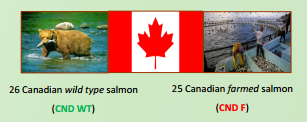
樣品:野生三文魚(26個、加拿大)和養殖的三文魚(25個、加拿大)
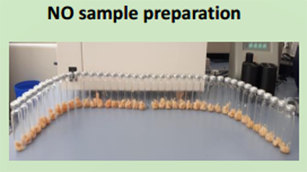
樣品無需前處理:稱取2g樣品于頂空瓶中,40℃條件下孵化5min
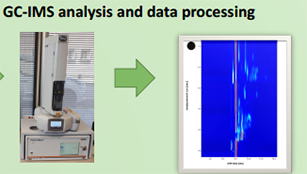
使用FlavourSpec®風味分析儀進行樣品的檢測和數據處理
結果:
野生三文魚和養殖三文魚共51個樣品(產地:加拿大),已采用DART-HRMS(實時直接電離串聯高分辨質譜)方法分析。為區分三文魚的養殖方式,使用FlavourSpec檢測其揮發性有機物。將檢測到的譜圖進行面積校準后,選取其中5個特征揮發性有機物進行PCA分析, 如圖1所示,野生三文魚、養殖三文魚和空白樣品能夠很好的區分,并且第一第二主成分(PC1和PC2)的數據之和約95%。
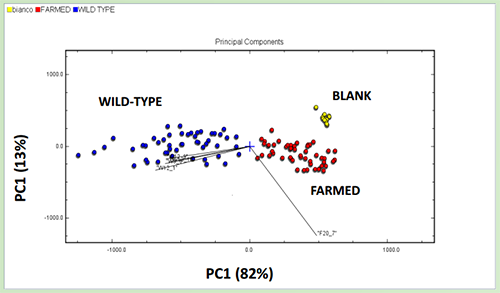
圖1. 51個加拿大三文魚的PCA圖(藍色是野生,紅色是養殖,黃色是空白)。每個三文魚做兩到三次平行。
第二種分析方法,采用監督的方式對所有的數據進行分析。在這個分析方法里,使用Statistica v. 7軟件選取較準后的5個特征標記物進行LDA分析。如圖2所示,可以得出一種判別式分析方法(Root 1)。由圖所所示,養殖三文魚和野生三文魚能夠明顯的區分開,且Root 1的數值達到88%。
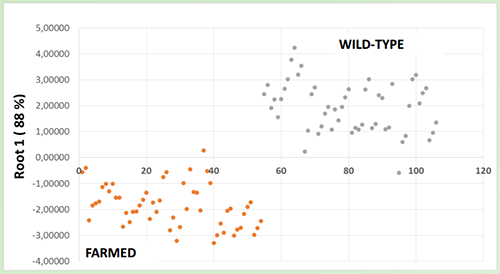
圖2. LDA Root 1譜圖
結論:
食品評價過程具有非常廣闊的應用前景,本文采用GC-IMS聯用技術檢測三文魚中的揮發性有機物,用以區分三文魚的養殖方式,同時該實驗亦可找到不同生長環境下三文魚的標記物。
參考文獻
[1].Gerhardt, N., Birkenmeier, M., Schwolow, S., Rohn, S., Weller, P. Volatile-Compound Fingerprinting by Headspace-Gas-Chromatography Ion-Mobility Spectrometry (HS-GC-IMS) as a Benchtop Alternative to1H NMR Profiling for Assessment of the Authenticity of Honey, Analytical Chemistry, 2018, 90, pp. 1777-1785.
[2]. Arroyo-Manzanares, N., Martín-Gómez, A., Jurado-Campos, N., Garrido-Delgado R, Arce, C., Arce, L. Target vs spectral fingerprint data analysis of Iberian ham samples for avoiding labelling fraud using headspace-gas chromatography–ion mobility spectrometry, Food Chemistry, 2018, 246, pp. 65-73
[3]. Cavanna, D., Zanardi, S., Dall'Asta, C., Suman, M. Ion mobility spectrometry coupled to gas chromatography: A rapid tool to assess eggs freshness, Food Chemistry, 2019, 271, pp. 691-696
[4]. Fiorino, G.M., Losito, I., De Angelis, E., Arlorio M., Logrieco, A.F., Monaci, L., Assessing fish authenticity by direct analysis in real time-high resolution mass spectrometry and multivariate analysis: discrimination between wild-type and farmed salmon, 2018, Food Research International, in press